

There are various questions and exercises about T accounts further below which you can use for practice. The contra account here used to describe what occurred is baking equipment. As a general rule, we use the opposite or contra account to describe the transaction. Remember, to debit means to make an entry on the left-hand side. Congrats, if you got through that, you are going to be doing pretty well with T accounts.

How are T-accounts used in accounting?
These errors may never be caught because a double entry system cannot know when a transaction is missing. T Accounts always follow the same structure to record entries – with “debits” on the left, and “credits” on the right. It is typically prepared at the end of an accounting period before financial statements Certified Bookkeeper are generated. They are a useful tool for both newcomers to accounting and veteran accountants alike to quickly map out the correct way to record a transaction.

How confident are you in your long term financial plan?
- A double entry system is considered complex and is employed by accountants or CPAs (Certified Public Accountants).
- It can be used to balance books by adding all transactions in a set of accounts so the total debits equal the total credits for each account.
- You know the sum of your debits and credits must match at the end, but so far, you have a 30,000 dollars debit and a 5,000 dollars credit.
- Having established the foundational principles of T-account recording, we now turn our attention to specific examples that demonstrate how these principles are applied in practice.
- The main reason T accounts are used is so accountants can see the different debits and credits that go into an account and make up the balance.
In this section, I’m going to go through different types of transactions, and I’ll be using T-accounts to display the movement of value through the business. I will use my coffee shop to represent a business throughout these examples. You can see the specific date, the description of the transaction and a running balance beside the debits and credits. T-accounts are used to track https://www.bookstime.com/articles/what-are-t-accounts debits and credits made to an account. Understanding the perks and uses of T-accounts can seriously boost your business’s financial management skills.
What are T Accounts?
It’s true that you can make a T account for any account but let’s take an account like cash. If you were to get cash coming in, you would add it to the debit side of the “T” account. If your business is paying money out, then you would subtract to the credit side.
- Metals and Co. has sold iron worth $50,000 to their customer named Factory Innovators on $30,000 cash and remaining on a credit basis.
- Accounts can also be displayed as a listing of transactions in the general ledger.
- To find the account balance, subtract the total debits from the total credits.
- They make sure expenses match up with the revenues they helped generate.
- Represented by a large letter T, this method allows accountants to track the financial transactions of a business with precision and clarity.
A general ledger is a formal representation of a company’s financial statements where the debit account and credit account records are validated with a trial balance. A general ledger offers comprehensive documentation of all financial transactions of the company over a certain period. A general ledger is the repository of all account-related information required to prepare a financial statement.
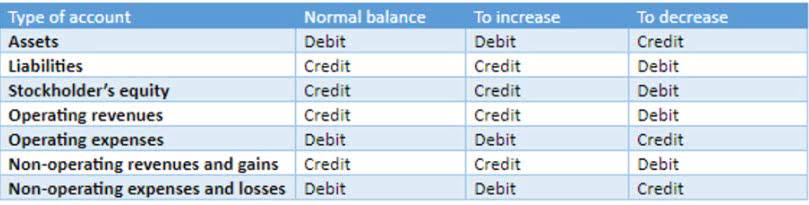
The matching principle in accrual accounting states that all expenses must match with revenues generated during the period. The T-account guides accountants on what to enter in a ledger to get an adjusting balance so that revenues equal expenses. The debit entry of an asset account translates to an increase to the account, while the right side of the asset T-account represents a decrease to the account. This means that a business that receives cash, for example, will debit the asset account, but will credit the account if it pays out cash.
- It is impossible to provide a complete set of examples that address every variation in every situation since there are hundreds of such T-accounts.
- Let’s look at some more typical examples of how T accounts help you determine how to record a transaction, particularly when more than two accounts are involved.
- Thousands of people have transformed the way they plan their business through our ground-breaking financial forecasting software.
- Think of a T-account as a simple visual tool that helps you see how transactions affect a business’s accounts.
- If you were to get cash coming in, you would add it to the debit side of the “T” account.
- The last piece of your transaction is to record the 25,000 dollars your business borrowed to purchase the truck.
Let us understand the concept in depth through understanding the related terminologies of a T account balance through the discussion below. Let us understand the format of a T account ledger and how it is designed in a way where it gives the individual reviewing it an ease of locating entries. Every month £2000 is credited from this account, reducing the asset as I make use of the property. Rent is classed as an operating cost as it’s a standard cost required to run my business.
Adjusting Entries
My inventory is reduced each time I sell a coffee so I need to credit the inventory account by 50p, reducing its value. T-accounts are also your best friend when it comes to tracking journal entries. This system, which records every transaction in at least two accounts, ensures that your books are always balanced. T-accounts are like a cheat sheet for seeing how debits and credits balance out.
Business owners can easily spot the nature of transactions and track the balance and movements of each account. This kind of transparency is a game-changer for making smart financial decisions. They help you keep track of adjusting entries and see how they affect your income statement. Having established the foundational principles of T-account recording, we now turn our attention to specific examples that demonstrate how these principles are applied in practice. T-account examples illuminate the standard types of T-accounts that are frequently encountered in accounting. Although a complete set of examples is expansive and Certified Public Accountant cannot encompass every possible variation, the essence of T-account usage is captured in a few illustrative scenarios.